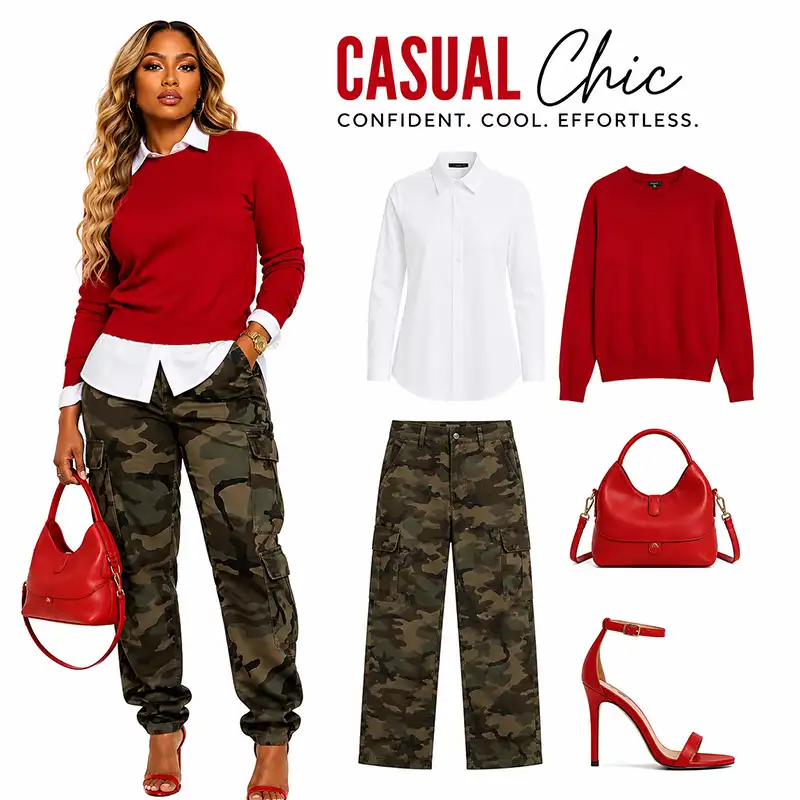
Most capsule wardrobe advice starts with "get rid of everything," which is exactly why most people never actually do it. The 3-3-3 rule skips the overwhelm entirely — pick 3 tops, 3 bottoms, and 3 pairs of shoes that all mix and match, and you've got over two dozen outfits without touching the rest of your closet.
Quick Answer
The 3-3-3 rule builds a mini capsule wardrobe from just 9 pieces — 3 tops, 3 bottoms, and 3 pairs of shoes — chosen so every top works with every bottom and every shoe. Nine interchangeable pieces create 27+ outfit combinations, which is why it's one of the fastest ways to fix decision fatigue without buying anything new or purging your whole closet.
Where the 3-3-3 Rule Came From
The 3-3-3 method started as a travel-packing trick — nine pieces, one carry-on, a week of outfits — before people realised the same maths works just as well on a closet at home. That origin is the reason it's so much easier to stick to than traditional capsule wardrobes: it was designed around constraint from the beginning, not around minimalism as a lifestyle.
The Math, Briefly
Three tops × three bottoms × three pairs of shoes gives you 27 distinct outfit combinations. Add a single jacket and that number doubles; add accessories, layering, and the option to tuck or untuck, and a nine-piece capsule wardrobe comfortably clears 50 genuinely different looks.
The point isn't the number itself. It's that nine pieces chosen to work together will always beat a closet full of pieces chosen in isolation.
Why 9 Pieces Beats a Full Closet Overhaul
Nine pieces that all genuinely work together create at least 27 distinct outfit combinations — more once you factor in layering and accessories. That's more actual variety than most overstuffed closets deliver, because a full closet full of one-off pieces usually means half of it doesn't mix with anything else.
"A closet with 60 pieces that don't talk to each other gives you fewer real outfits than 9 pieces that do."
Pick Your Palette Before You Pick Pieces
This is the step almost every 3-3-3 attempt skips, and it's the main reason people end up with nine pieces that don't actually combine. Before choosing a single item, decide on three colours:
- A base neutral — black, navy, or chocolate brown; this anchors your bottoms and shoes
- A supporting neutral — white, cream, grey, or camel; this carries most of your tops
- One accent — a single colour or print you actually like wearing, used once or twice at most
Every piece you choose has to belong to that palette. If an item doesn't sit comfortably with the other two colours, it isn't a 3-3-3 piece, no matter how much you like it on its own.
The easiest palettes to start with: black, white, and denim. Or brown, cream, and camel. Both are almost impossible to get wrong.
Step 1: Choose Your 3 Bottoms First
Bottoms are the hardest piece to match, so build around them, not your tops. Pick pieces in colors that work with everything:
- A dark, versatile denim
- A neutral tailored trouser (black, camel, or grey)
- One more textured or colored piece you already reach for often
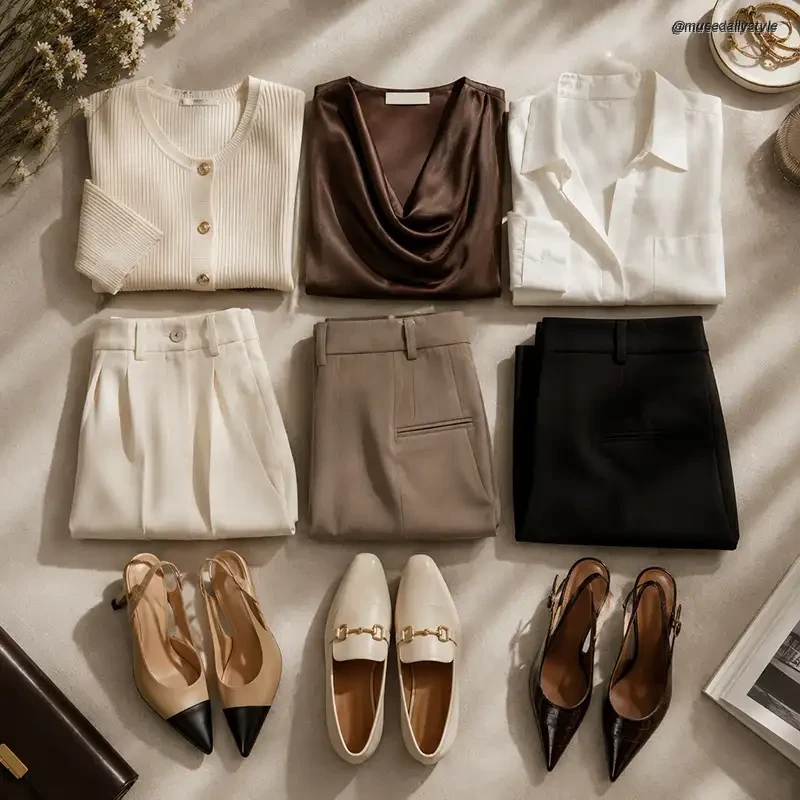
A worked example: dark straight-leg jeans, black tailored wide-leg trousers, and a cream denim or khaki chino. All three are neutral, all three take the same shoes, and none of them fights a printed top.
Step 2: Choose 3 Tops That Work With All 3 Bottoms
This is the actual test of the whole system — every top needs to work with every bottom, not just your favorite pairing. If a top only works with one specific pair of pants, it's not a 3-3-3 piece, even if you love it. Look for:
- One neutral basic (white tee or tank)
- One slightly dressier option (blouse or fitted knit)
- One with a bit of personality (print, texture, or color)
A worked example: a white cotton tee, a black or cream fitted knit, and a striped or polka dot blouse. Nine combinations from those three tops alone, and every one of them works.

Step 3: Choose 3 Shoes That Cover Your Actual Week
Rather than picking shoes by how much you love them, pick them by what you actually need:
- One everyday flat or sneaker
- One slightly dressier option (loafer or low heel)
- One that handles your outlier occasion (a boot for cold days, a sandal for hot ones)
A worked example: white leather sneakers, brown loafers, and ankle boots. Between them they cover errands, the office, and dinner — and all three work with every bottom on the list above.
How to Test Your 9 Before You Commit
Don't assume the combinations work. Lay all nine pieces out on a bed and physically pair every top with every bottom, one at a time. For each of the nine pairings, ask a single question: would I actually leave the house in this?
Count the yeses. If you're at 20 or above, your capsule is solid. If you're below 20, one piece is failing — and it's almost always the one you chose because you loved it rather than because it matched.
Swap that piece out and test again. The whole exercise takes about fifteen minutes and saves you months of a capsule wardrobe that quietly doesn't work.
The 3-3-3 Rule for Different Lifestyles
The nine slots stay the same, but what fills them should reflect your actual week rather than an idealised one.
Office-based: tailored trousers, dark denim, a midi skirt / white shirt, fine knit, silk-feel blouse / loafers, low block heels, ankle boots.
Working from home: dark denim, wide-leg trousers, relaxed knit trousers / cotton tee, oversized knit, button-down shirt / sneakers, flat mules, ankle boots.
Student: straight-leg jeans, cargo or wide-leg trousers, a knit skirt / graphic or plain tee, hoodie or sweatshirt, fitted long-sleeve / sneakers, chunky boots, flat sandals.
Travel: dark jeans, black trousers, a wrinkle-resistant midi skirt / two tees, one blouse that dresses up / sneakers, sandals, one dressier flat.
Mix In What You Already Own
The 3-3-3 rule isn't meant to replace your whole wardrobe — it's a framework. Once the 9 core pieces are solid, everything else you own becomes an easy add-on: a jacket, a scarf, jewelry, a bag, all layered onto outfits that already work.

Seasonal Swaps
You don't rebuild the capsule every season — you rotate three or four pieces and keep the rest. The palette stays the same, which is what makes the swaps painless.
- Spring to summer: trade the knit for a linen shirt, the boots for flat sandals, the heavy trouser for something lighter
- Autumn to winter: trade the tee for a long-sleeve, the sandals for boots, add a heavier knit in the same palette
- Keep year-round: your dark denim, your neutral trouser, and your everyday sneaker or flat
Doing this four times a year takes about twenty minutes each time and keeps the system from going stale.
What the 3-3-3 Rule Doesn't Cover
Worth being clear about, so you don't think the system is broken when it doesn't stretch:
- Outerwear — coats and jackets sit outside the nine and layer over everything
- Underwear, loungewear, and workout clothes — not part of the count
- Formal events — a wedding or black-tie occasion needs its own piece; that's normal
- True outliers — a ski trip, a funeral, a job interview in a dress code you don't normally wear
The nine pieces are for your ordinary week. Everything else is an exception, and exceptions don't invalidate the framework.
Common Mistakes to Avoid
- Choosing pieces you love individually instead of testing whether they actually mix with the other 8.
- Picking 3 bottoms in different, competing colors instead of one cohesive palette.
- Treating this as a one-time exercise instead of updating it seasonally.
- Skipping step 1 and starting with tops — bottoms are harder to match, so they should drive the rest of your choices.
- Buying all nine pieces new instead of building from what you already own and reach for.
- Choosing three shoes you like over three shoes that cover your actual week.
Key Takeaways
- 9 well-chosen pieces (3 tops, 3 bottoms, 3 shoes) can create 27+ real outfit combinations.
- Build around your bottoms first — they're the hardest piece to match.
- Choose your colour palette before you choose any pieces; this is what makes the nine actually mix.
- Test all nine physically before committing — under 20 workable pairings means a piece is failing.
- This is a framework, not a full wardrobe — layer in jackets, accessories, and jewelry you already own.
- Rotate three or four pieces seasonally rather than rebuilding from scratch.
- Decision fatigue comes from too many one-off pieces, not too few clothes.
Frequently Asked Questions
Is the 3-3-3 rule the same as a capsule wardrobe? It's a simplified version. A traditional capsule wardrobe usually runs 30–40 pieces across a season, while the 3-3-3 rule strips it down to nine core items — which makes it a much easier starting point.
How long should you wear a 3-3-3 capsule? Most people run one for a month or a season. It works well as a short experiment first, then as a seasonal system once you know your nine pieces genuinely combine.
Can you include dresses in the 3-3-3 rule? Yes. Count a dress as a top-and-bottom combined, or swap it in for one top and one bottom. The maths shifts slightly, but the principle — everything must work with everything — stays the same.
Does the 3-3-3 rule work for every body type? Yes, because it's a system for combining pieces, not a prescribed list of what to buy. Choose the cuts and silhouettes you already know you're comfortable in and apply the framework to those.
How often should you update your 9 pieces? Every season, roughly four times a year, swapping three or four pieces rather than rebuilding. Keep the palette and the core neutrals constant.
Do you need to buy new clothes to start? No — and you shouldn't. Build your first nine entirely from what you already own. Only after testing them will you know whether there's a genuine gap worth filling.
Final Thoughts
Decision fatigue happens when every item in your closet is a fresh decision. Nine pieces that already work together means getting dressed stops being a puzzle every morning — it's just picking from a list of outfits you already know work.
Start with what's already in your closet, keep the palette tight, and test the combinations before you commit. That's the whole system.